Are you a journalist looking for climate experts for COP30? We’ve got you covered

We’ve got lots of media trained climate change experts at the University of Bristol. If you need an expert for an interview, here is a list of our experts you can approach. All media enquiries should be made via press-office@bristol.ac.uk.

Cabot Institute for the Environment at COP30

We will have four academics in attendance at the Blue Zone at COP30 who will be available for media interviews. These are: Dr Alice Venn (climate law, loss and damage, just transition), Dr Filipe França (Amazon rainforest changes, deforestation, biodiversity), Dr Laurence Hawker (population mapping, flooding, climate hazards) and Dr Karen Tucker (indigenous knowledges). We will also have several academics attending virtually: Dr Alix Dietzel, Dr Katharina Richter, Dr Ailish Craig, Dr Ruby Lieber, and Stefan Zylinski.

Read more about our participation at COP on our website at https://bristol.ac.uk/cabot/what-we-do/projects/cop/

Action for Climate Empowerment & Children and Youth

Dr Dan O’Hare – expert in climate anxiety in children and educational psychologist.

Dr Camilla Morelli – expert in how children and young people imagine the future, asking what are the key challenges they face towards the adulthoods they desire and implementing impact strategies to make these desires attainable.

Dr Helen Thomas-Hughes – expert in engaging, empowering, and inspiring diverse student bodies as collaborative environmental change makers. Also Lead of the Cabot Institute’s MScR in Global Environmental Challenges.

Professor Daniela Schmidt – expert in the causes and effects of climate change on marine systems. Dani is also a Lead Author on the IPCC reports. Also part of the Waves of Change project with Dr Camilla Morelli, looking at the intersection of social, economic and climatic impacts on young people’s lives and futures around the world.

Dr Oscar Berglund – expert on climate change activism and particularly Extinction Rebellion (XR) and the use of civil disobedience.

Climate finance / Loss and damage

Dr Rachel James – Expert in climate finance, damage, loss and decision making. Also has expertise in African climate systems and contemporary and future climate change.

Dr Katharina Richter – an expert in sufficiency-based, postgrowth climate change mitigation approaches and the environmental justice aspects of global energy transitions. Her regional expertise is in Latin America, focussing on sustainable and equitable development in times of climate crisis, with a particular emphasis on the impacts of critical raw materials extraction on biodiverse, water scarce and/or indigenous territories, and indigenous alternatives to growth-based development such as Buen Vivir. Katarina will be virtually attending COP30.

Dr Josephine Walker – health economic modelling.

Climate science / Adaptation and resilience / Mitigation

Dr Laurence Hawker – expert on refugees, flooding, population mapping, displaced people, hazards. Laurence will be at COP30 between 17 and 21 November 2025.

Dr Katharina Richter – an expert in sufficiency-based, postgrowth climate change mitigation approaches and the environmental justice aspects of global energy transitions. Her regional expertise is in Latin America, focussing on sustainable and equitable development in times of climate crisis, with a particular emphasis on the impacts of critical raw materials extraction on biodiverse, water scarce and/or indigenous territories, and indigenous alternatives to growth-based development such as Buen Vivir. Katarina will be virtually attending COP30.

Dr Ailish Craig – expert in improving climate services and climate adaptation across Southern Africa. Ailish will be attending COP30 virtually.

Dr Eunice Lo – expert in changes in extreme weather events such as heatwaves and cold spells, and how these changes translate to negative health outcomes including illnesses and deaths.

Professor Lizzie Kendon – Lizzie is a Scientific Manager and Met Office Science Fellow at the Met Office and University of Bristol. She is an expert in using climate models to understand future changes in high impact weather events.

Professor Daniela Schmidt – expert in the causes and effects of climate change on marine systems. Daniela is also a Lead Author on the IPCC reports.

Dr Katerina Michalides – expert in drylands, drought and desertification and helping East African rural communities to adapt to droughts and future climate change.

Professor Dann Mitchell – expert in how climate change alters the atmospheric circulation, extreme events, and impacts on human health. Dann is also a Met Office Chair.

Professor Dan Lunt – expert on past climate change, with a focus on understanding how and why climate has changed in the past and what we can learn about the future from the past. Dan is also a Lead Author on IPCC AR6.

Professor Jonathan Bamber – expert on the impact of melting land ice on sea level rise (SLR) and the response of the ocean to changes in freshwater forcing.

Professor Paul Bates CBE – expert in the science of flooding, risk and reducing threats to life and economic losses worldwide.

Dr Matt Palmer – expert in sea level and ocean heat content at the Met Office Hadley Centre and University of Bristol.

Professor Guy Howard – expertise in building resilience and supporting adaptation in water systems, sanitation, health care facilities, and housing. Expert in wider infrastructure resilience assessment.

Dr Ryerson Christie – expert in human security, peacebuilding, and natural disasters.

Dr Emily Vosper – hurricane and climate science expert.

Climate techonology

Dr Ce Zhang – expert in environmental data science including Machine Learning and Artificial Intelligence (AI), Geospatial Data Mining and Modelling, Landscape Pattern and Process Modelling, Remotely Sensed Image Analysis and their Applications.

Climate change and health

Dr Dan O’Hare – expert in climate anxiety and educational psychologist.

Professor Dann Mitchell – expert in how climate change alters the atmospheric circulation, extreme events, and impacts on human health. Dann is also a Met Office Chair.

Dr Eunice Lo – expert in changes in extreme weather events such as heatwaves and cold spells, and how these changes translate to negative health outcomes including illnesses and deaths.

Professor Guy Howard – expert in influence of climate change on infectious water-related disease, including waterborne disease and vector-borne disease.

Professor Rachael Gooberman-Hill – expert in health research, including long-term health conditions and design of ways to support and improve health.

Dr Adrian Flint – expert in poverty, sustainable development, disease and political economy.

Dr Josephine Walker – health economic modelling.

Just transition

Dr Alix Dietzel – climate justice and climate policy expert. Focusing on the global and local scale and interested in how just the response to climate change is and how we can ensure a just transition. Alix will be attending COP30 virtually.

Dr Ed Atkins – expert on environmental and energy policy, politics and governance and how they must be equitable and inclusive. Also interested in local politics of climate change policies and energy generation and consumption.

Dr Karen Tucker – expert on colonial politics of knowledge that shape encounters with indigenous knowledges, bodies and natures, and the decolonial practices that can reveal and remake them. Karen will be in attending the Blue Zone of COP30 between 10 to 15 November 2025.

Dr Katharina Richter – an expert in sufficiency-based, postgrowth climate change mitigation approaches and the environmental justice aspects of global energy transitions. Her regional expertise is in Latin America, focussing on sustainable and equitable development in times of climate crisis, with a particular emphasis on the impacts of critical raw materials extraction on biodiverse, water scarce and/or indigenous territories, and indigenous alternatives to growth-based development such as Buen Vivir. Katarina will be virtually attending COP30.

Land Use / Forests / Nature / Food

Dr Filipe França – expert on changes in tropical Amazonia forests including biodiversity, logging, land use etc. Filipe will be in the Blue Zone of COP30 from 10 to 15 November 2025.

Dr Jo House – expert on land and climate interactions, including emissions of carbon dioxide from land use change (e.g. deforestation), climate mitigation potential from the land (e.g. afforestationbioenergy), and implications of science for policy. Previously Government Office for Science’s Head of Climate Advice.

Dr Taro Takahashi – expert on farminglivestock production systems as well as programme evaluation and general equilibrium modelling of pasture and livestock-based economies.

Dr Maria Paula Escobar-Tello – expert on tensions and intersections between livestock farming and the environment.

Local Communities and Indigenous Peoples

Dr Camilla Morelli – expert in how children and young people imagine the future, asking what are the key challenges they face towards the adulthoods they desire and implementing impact strategies to make these desires attainable.

Dr Katharina Richter – expert in decolonial environmental politics and equitable development in times of climate crises. Also an expert on degrowth and Buen Vivir, two alternatives to growth-based development from the Global North and South. Katarina will be virtually attending COP30.

Dr Karen Tucker – expert on colonial politics of knowledge that shape encounters with indigenous knowledges, bodies and natures, and the decolonial practices that can reveal and remake them. Karen will be in attending the Blue Zone of COP30 between 10 to 15 November 2025.

Dr Maria Paula Escobar-Tello – expert on tensions and intersections between livestock farming and the environment.

Net Zero / Energy / Renewables

Dr Sam Williamson – sustainable and equitable energy systems.

Dr Caitlin Robinson – expert on energy poverty and energy justice and also in mapping ambient vulnerabilities in UK cities.

Professor Charl Faul – expert in novel functional materials for sustainable energy applications e.g. in CO2 capture and conversion and energy storage devices.

Oceans

Professor Steve Simpson – expert marine biology and fish ecology, with particular interests in the behaviour of coral reef fishes, bioacoustics, effects of climate change on marine ecosystems, conservation and management.

Professor Daniela Schmidt – expert in the causes and effects of climate change on marine systems. Daniela is also a Lead Author on the IPCC reports.

Pollution

Dr Aoife Grant – expert in greenhouse gases and methane. Set up a monitoring station at Glasgow for COP26 to record emissions.

Professor Matt Rigby – expert on sources and sinks of greenhouse gases and ozone depleting substances.

Professor Guy Howard – expert in contribution of waste and wastewater systems to methane emissions in low- and middle-income countries

Dr Charlotte Lloyd – expert on the fate of chemicals in the terrestrial environment, including plasticsbioplastics and agricultural wastes.

Dr Jagannath Biswakarma – expert in water quality, pollution and treatment. Water contamination.

Cities

Dr Ges Rosenberg – investigates how ‘systems’ approaches (‘systems thinking’ and ‘systems engineering’) can be applied to structure socio-technical problems, and to design and analyse a wide range of engineering solutions and policy interventions, with specific application to infrastructure and city futures.
——————————
This blog was written by Amanda Woodman-Hardy, Communications and Engagement Officer at the Cabot Institute for the Environment.

Building resilience of the UK food system to weather and climate shocks

Climate-driven changes in extreme weather events are one of the highest-risk future shocks to the UK food system, underlining the importance of preparedness across the food chain. However, the CCC’s 2023 report on adaptation progress highlighted that current climate adaptation plans and policies, and their delivery and implementation for UK food security are either insufficient or limited. Through an ongoing Met Office cross-academic partnership activity (‘SuperRAP’) working across all eight partner universities (including Bristol), Defra, the Food Standards Agency, UKRI-BBSRC and the Global Food Security Programme, a recent perspective paper, and associated online workshops and surveys in January 2023 have:  

  • Scoped out the direct impacts of weather and climate extremes on the UK food supply chain, 
  • Highlighted areas where weather and climate information could support resilience across time and space scales through decision making and action, 
  • Identified key knowledge gaps, 
  • Made recommendations for future research and funding, and 
  • Scoped out the potential adaptation/policy responses to the direct impacts of weather and climate extremes on the food chain, and the resulting trade-offs and consequences  
The potential for weather and climate information to support decision making in agricultural and food system-related activities, and improved resilience to weather and climate shocks across time and space scales. Grey background boxes represent generalised meteorological capabilities; light blue ellipses with white outlines denote potential applications. © Crown Copyright 2021, Met Office. From Falloon et al. 2022.

However, a major gap remains in understanding the changes needed to rapidly increase the delivery and implementation of climate adaptation in support of resilience in the UK food system. A workshop on this topic was held at the University of Reading’s Henley Business School on 13-14 June 2024 bringing together academics across a wide range of disciplines and presented findings back to industry and government stakeholders for their feedback and prioritisation.  

The workshop aimed to consider key areas for supporting resilience and adaptation to climate change identified by the January 2023 workshop including innovation and trialling novel management and production approaches, social innovation and enabling behavioural shifts, mutual learning, and underpinning evidence gaps. The workshop was supported by a cross-sector survey on adaptation barriers and priorities. 

Overarching themes identified in the workshop included the need for a strategic, system-wide, and long-term approach, underpinned by strong inter- and transdisciplinary collaboration. 

Critical evidence gaps include improving understanding of: 

  • Impacts of international dimensions and trade on UK food ingredient and packaging availability, compared to UK-sourced products – and their interactions
  • Impacts of climate extremes on production and transport and effective adaptation options
  • Impacts of climate shocks on UK livelihood systems, households and consumers
  • Broader adaptation and transformation needed to escape existing ‘doom loops’
  • Application of tech solutions (e.g. GM/gene editing) for climate resilience and adaptation

Other issues raised included thresholds for change, land pressures, substitutability of different foods, impacts of government policy, nutrition, regenerative practices, and interactions with the energy sector. 

Recommended ways forward include: 

  • Tools, models, and methods that consider risks across the food chain and system outcomes
  • A focus on inter- and trans-disciplinary approaches.
  • Increased international collaboration/cooperation, and stronger government-science interactions
  • Enhancing food chain data access, use and integration, and a supportive enabling environment
  • Long-term trials: to provide evidence of impacts of alternative practices
  • Preparing the transport network for climate extremes.
  • A refresh of the National Food Strategy, building on latest science
  • A new funding landscape: long-term, strategic, visionary, systemic, trans- and interdisciplinary, co-designed and coordinated.

Other issues raised included: sharing responsibility and joined-up, transparent approaches across sectors and institutions; risk mitigation tools; use cases and roadmaps; welfare responses; interdisciplinary skills training; and research across a wider range of crops. 

We are aiming to produce a peer-reviewed perspective paper on critical research (and practice) gaps, and recommendations for the way forward.  

———————————–

This blog was written by Professor Pete Falloon from the Cabot Institute for the Environment and Met Office.

A bald headed man smiling with dark rimmed glasses.
Professor Pete Falloon

How do you manage a dam when there’s a tropical cyclone in Mozambique?

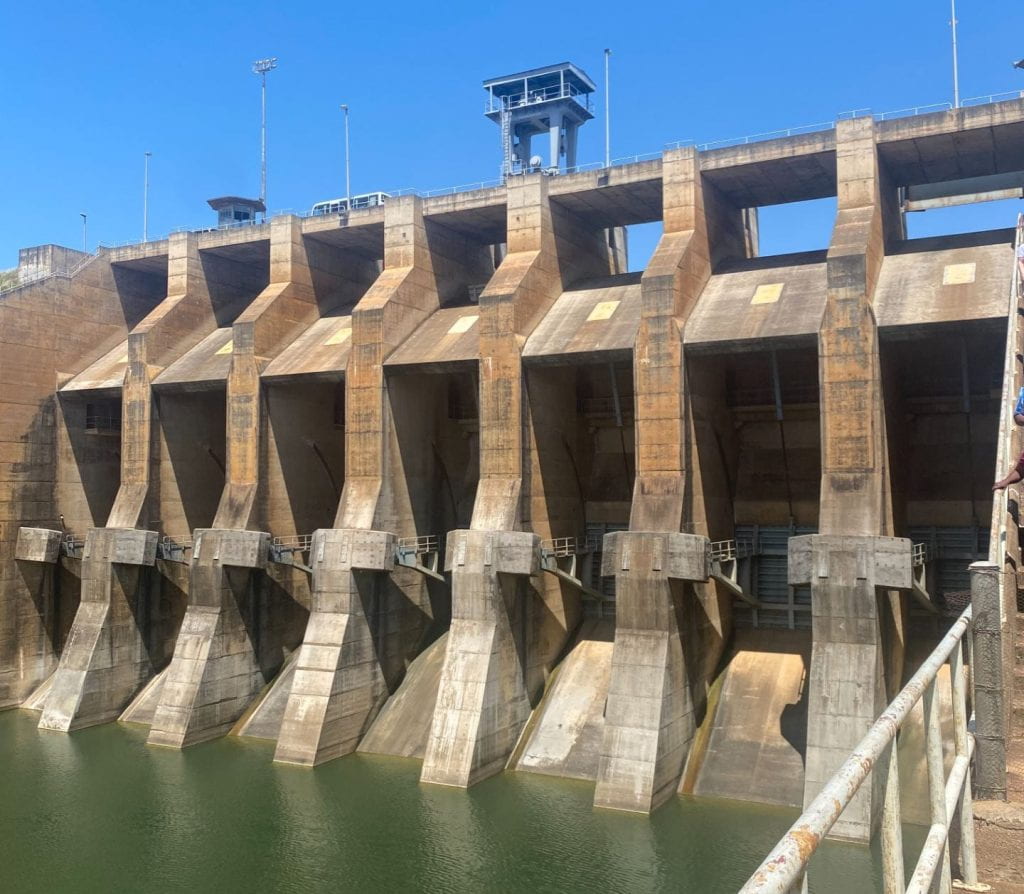
Mozambique dam

I’d never given a huge amount of thought of what a dam manager did until I visited Pequenos Libombos dam in Mozambique in October 2023. Standing at the dam, in hot conditions, listening to the lived experience of people who work on the ground and explain what they do during a tropical cyclone leaves you with more understanding than any peer reviewed journal article. Context is everything. It’s why visiting the countries I’m researching is something I do given the chance.

That’s what members of Bristol projects REPRESA (co-led by Prof Elizabeth Kendon at University of Bristol & UK Met Office, Dr Luis Artur from Eduardo Mondlane University and Prof Francois Engelbrecht from University of the Witwatersrand) and SALIENT (led by Dr Rachel James, University of Bristol) did in October. The REPRESA project aims to understand compound tropical cyclone risks, impacts of tropical cyclones and improve early warning systems in Mozambique, Malawi and Madagascar. Seeing the research alignment in projects, the SALIENT team also joined. The SALIENT project aims to improve the characterisation and communication of future climate information for national adaptation planning in southern Africa.

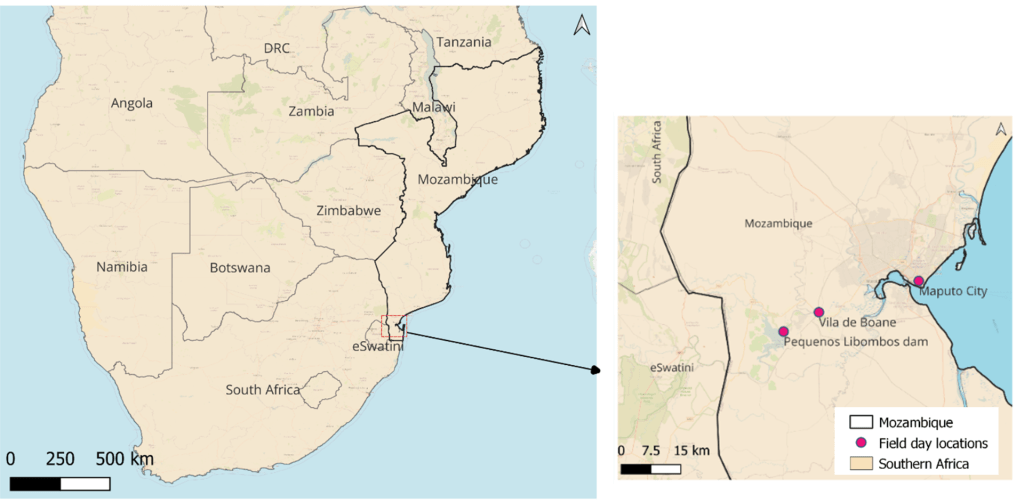
On the field trip day, we travelled to Pequenos Libombos dam and heard from a government official from the Vila De Boane Municipality. It was this day where I had my epiphany that if I ever left academia, dam management is not my calling. Providing water to the local population is the dams primary role and it provides 2 million people within Maputo Province with access to water. That is more than 4 times the population of Bristol.

The management of Pequenos Libombos dam is difficult as there are many other people and industries to consider and keep safe and happy when making decisions. From the businesses who want to use the dam’s water for industrial purposes to the farming communities that are reliant on the water for irrigation, and hydroelectricity companies that want to use the dam to create energy to the communities downstream that may be flooded if the dam releases water too quickly. The dam catchment is also shared with 2 of Mozambique’s neighbouring countries; eSwatini and South Africa, adding another element of complexity to the dams management.

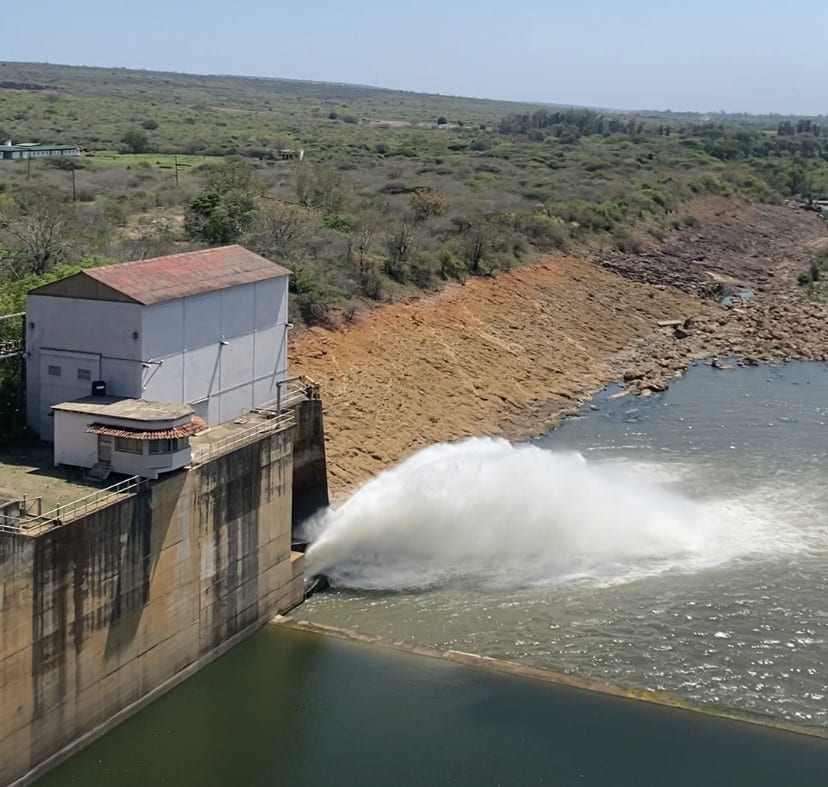
Management must carefully balance both periods of water surplus and deficit and Maputo has experienced numerous extreme weather events in recent years.  The 2015-2016 southern African drought impacted Central and Southern Mozambique and more recently the remnants of tropical cyclones in 2019, 2011, 2022 and 2023. During February 2023, Tropical Cyclone (TC) Freddy passed over Madagascar and southern Mozambique before returning a couple of weeks later to central Mozambique. It is thought to be the longest lived and have the highest accumulated cyclone energy of any cyclone on record, awaiting formal investigation from the World Meteorological Organization. Although TC Freddy didn’t directly pass over Pequenos Limbombos, its associated rainfall resulted in 250 mm of rainfall at the dam in one day. For context, the Bristol experiences 265mm rainfall, on average, in October, November and December combined. To avoid a breach of the dam, discharge was released at the maximum rate, which is more than 500 time more than normal.

Globally there is evidence that TCs and their impacts are being impacted by climate change. The frequency, intensity and storm tracks of TCs may be changing meanwhile, rising sea levels may lead to higher storm surges. Yet we know a limited amount about how tropical cyclones may act in a future with increased global sea surface and air temperatures.  TCs in the Indian Ocean are particularly under researched, but recent and frequent events have highlighted the importance of understanding TCs in a changing climate.

After hearing about the vast amount of rain that fell in February 2023, we walk past the disused hydroelectric generator that was forced to cease operation during the drought as it was no longer economically viable. It really hammered home the complexities faced when trying to manage such a huge piece of infrastructure during extreme events. Similarly, it is clear why research projects like REPRESA and SALIENT are needed to understand how tropical cyclones may behave in the future and explore how early warning systems and climate change adaptation can be strengthened.

Mozambique dam

The human side of extreme weather

After the talk at Pequenos Libombos Dam, we visited the Municipality of Vila de Boane. Vila de Boane is located roughly 15 km downstream from the dam and the River Umbuluzi passes through the municipality. The municipality experienced large scale flooding after the dam was forced to increase to maximum discharge during the February 2023 rainfall.

Despite already hearing about TC’s Freddy’s impacts at the dam, they were not as focused on the human impact. The leader of the municipality compellingly described how 16,000 people were impacted overnight, 6000 people were displaced and 6 people sadly died. The community water pump was destroyed, leaving people without water for 3 months. The municipality leader said he had never seen that amount of water passing through the municipality at such high speed before. Meanwhile, money that had been budgeted for development initiatives, had to be redirected to repair and response. It was not clear if extra money had been sourced for the development initiatives.

It was also highlighted that the increased release of water from the dam occurred over night with little warning. The municipality had been told to expect “above normal” rainfall and to avoid being close to rivers and move farming machinery further inland. But as the municipality leader questioned, what does “above normal” actually mean? People will perceive this message differently, which will influence how they act upon it. As part of the SALIENT research project, I am researching how we best communicate future climate information to decision makers and this anecdote will stay with me. It’s clear that improved communications are needed in both weather and climate services, something REPRESA is also aiming to research further.

Reflections and collaboration

After hearing about the vast amount of impacts the flooding had on Villa de Boane, we waited for our transport back to Maputo under the shade as it was too hot to stand in the sun. It was clear everyone from the REPRESA and SALIENT teams, both physical scientists and social scientists, had taken a lot from the field day. There was discussion about what the research should consider as well as the different angles that could be taken. It also fostered collaboration, SALIENT team member, Alan-Kennedy Asser, is providing the REPRESA team with analysis of precipitation trends from a multiple ensembles of climate models to characterise the range in future projections over the region. Meanwhile I spoke with some REPRESA team members in more depth about future climate information and will be providing risk communication training session in the future.

My personal key take away is that understanding the context and hearing the lived experiences of people working and living with extreme weather events enriches me as a researcher. Similarly, collaborating with researchers and practitioners on different projects enhances your work by providing questions and inputs from different standpoints. And finally, I’m too indecisive a person to ever be a good dam manager.

——————————————

This blog is written by Cabot Institute for the Environment member, Dr Ailish Craig, School of Geographical Sciences, University of Bristol with contributions from Dr Alan Kennedy-Asser, School of Geographical Sciences, University of Bristol and Dr Rachel James, School of Geographical Sciences, University of Bristol.

Ailish Craig
Dr Ailish Craig

Navigating divorce and environmental challenges: Implications in a changing world

Broken heart on wooden table.In an ever-evolving world, societal dynamics are continually shifting, reflecting the multifaceted nature of the human experience. One of the most profound changes we have witnessed in recent decades is the transformation of family structures, with divorce becoming a common facet of modern life across various societies. For instance, according to Office for National Statistics as of 2021, 42% of marriages in England and Wales end in divorce. Alongside this social evolution, we grapple with an equally pressing issue—the burgeoning environmental emergency. These two forces converge dramatically in more profound ways than we might realise. In this blog, I will explore the profound impact of dealing with divorce within the context of logistical and emotional anxiety brought about by the existential threat to our environment. 

The complex landscape of divorce

Divorce, a life-altering event, affects not just the couple but an entire ecosystem—that is to say, the nuclear family. My PhD research findings illuminated the diverse experiences of young people whose parents divorced in different cultural contexts. After interviewing forty-four young people aged between 11 and 16 in Türkiye and England, what emerged strongly was a nuanced understanding of the variegated effects – both uplifting and otherwise, of divorce particularly for children. 

For instance, more than half of the Turkish young people reported changing schools due to their parents’ divorce. While many didn’t directly attribute their school performance to the divorce, several children noted that changing schools positively impacted their performance. This aligns with global trends. A changing world demands adaptability, and some young people see education as their anchor, providing hope and a chance to take control of their lives, as reported by older participants in my study. 

Emotional turmoil is a common aspect of divorce, with sadness and confusion being initial reactions. However, as my research indicates, many young people learn to adapt and grow from their experiences over time. Young people also emphasised the pivotal role that the home environment plays in shaping children’s experiences during and after divorce. Exposure to violence or maltreatment within the family environment can have a lasting negative impact. 

Environmental challenges as an added layer

While navigating the intricate terrain of divorce, families now face an additional layer of complexity—the environmental challenges we face as a society. The world around us is changing rapidly due to issues such as climate change, pollution, and resource depletion. These challenges bring new dynamics to the fore within family life. A changing world presents economic challenges for families. Natural disasters, resource scarcity, or environmental policies have disrupted livelihoods and strained family finances, each feeding into existing marital tensions and ultimately increasing the likelihood of divorce. According to the World Economic Forum, climate change and related disasters could cost the global economy $360 billion annually by 2030. 

Environmental crises force families to relocate or to become displaced persons, creating stress and uncertainty. The number of internally displaced people around the world reached 71.1 million as of the end of 2022, an increase of 20% from the previous year, according to the Internal Displacement Monitoring Centre’s flagship annual report. Today’s displacement crises are growing in scale, complexity and scope, and factors like food insecurity, climate change, and escalating and protracted conflicts are adding new layers to this phenomenon. 

The emotional toll of witnessing environmental devastation can affect family members’ mental health. Anxiety, depression, and a sense of helplessness may surface, adding to the existing emotional challenges of divorce. The Mental Health Foundation in the UK has highlighted the impact of environmental issues and climate change on mental health, that stress and anxiety are rising. 

A call for resilience and adaptation

As we stand at the crossroads of these two significant societal shifts—divorce and environmental challenges—it becomes clear that resilience and adaptation are paramount. Families must not only weather the storms of marital dissolution but must also equip themselves to confront the environmental storms of a changing world. 

Empowering young people with education and awareness about both divorce and environmental issues is crucial. They need the tools to understand, adapt, and make positive contributions to their lives and the world around them. Families need robust support systems. This includes access to mental health services for emotional well-being and community networks that can assist during economic hardship or environmental crises. 

Having to separate houses also means having to double the expenses for two different households. While divorce can bring about significant changes and challenges, it is important to recognise that it can also have positive aspects, such as the potential for personal growth and the opportunity to create healthier family dynamics. In my research, 95% of the young people said they feel happier after their parents’ divorce than before and during. Therefore, sustainable living practices can help mitigate the impact of both divorce and environmental challenges. This not only contributes to the preservation of the planet but also instils values of responsibility and resilience in younger generations. Divorce cannot solely be seen as a breakdown of a family unit. On the contrary, families can advocate for action on environmental issues, fostering a sense of purpose and unity. Addressing these challenges collectively can lead to positive changes that benefit the family unit and the world. 

In our rapidly changing world, families often find themselves at the intersection of two transformative forces—personal and environmental upheaval. At first glance, divorce and environmental challenges may seem unrelated. However, the two have a profound connection. Studies have shown that the environment plays a significant role in shaping our mental health and well-being. The increasing prevalence of climate change-related stress and anxiety, as documented by the American Psychological Association, highlights this link.

When we realise that environmental changes impact our mental health, we can begin to see the intricate relations between these forces. By acknowledging the complexity of divorce within the context of a changing world, understanding the implications of environmental challenges on our emotional well-being, and fostering resilience and adaptation, we can empower families to not only survive but thrive in this shifting landscape. Ultimately, through these challenges, we can shape a more compassionate, resilient, and sustainable world for generations to come. 


This blog is written by Dr Gozde Burger, whose PhD is on young people’s experiences of parental divorce in Türkiye and England. She is currently working as part of the GW4 Alliance as a Senior Research Coordinator. Contact: Gozde.burger@bristol.ac.uk.

Gozde Burger
Gozde Burger

Towards urban climate resilience: learning from Lusaka


“This is a long shot!”

These were the words used by Richard Jones (Science Fellow, Met Office) in August 2021 when he asked if I would consider leading a NERC proposal for a rapid six-month collaborative international research and scoping project, aligned to the COP26 Adaptation and Resilience theme. The deadline was incredibly tight but the opportunity was too good to pass up – we set to work!

Background to Lusaka and FRACTAL

Zambia’s capital city, Lusaka, is one of Africa’s fastest growing cities, with around 100,000 people in the early 1960s to more than 3 million people today. 70% of residents live in informal settlements and some areas are highly prone to flooding due to the low topography and highly permeable limestone sitting on impermeable bedrock, which gets easily saturated. When coupled with poor drainage and ineffective waste management, heavy rainfall events during the wet season (November to March) can lead to severe localised flooding impacting communities and creating serious health risks, such as cholera outbreaks. Evidence from climate change studies shows that heavy rainfall events are, in general, projected to increase in intensity over the coming decades (IPCC AR6, Libanda and Ngonga 2018). Addressing flood resilience in Lusaka is therefore a priority for communities and city authorities, and it became the focus of our proposal.

Lusaka was a focal city in the Future Resilience for African CiTies and Lands (FRACTAL) project funded jointly by NERC and DFID from 2015 to 2021. Led by the Climate System Analysis Group (CSAG) at the University of Cape Town, FRACTAL helped to improve scientific knowledge about regional climate in southern Africa and advance innovative engagement processes amongst researchers, practitioners, decision-makers and communities, to enhance the resilience of southern African cities in a changing climate. I was lucky enough to contribute to FRACTAL, exploring new approaches to climate data analysis (Daron et al., 2019) and climate risk communication (Jack et al., 2020), as well as taking part in engagements in Maputo, Mozambique – another focal city. At the end of FRACTAL there was a strong desire amongst partners to sustain relationships and continue collaborative research.

I joined the University of Bristol in April 2021 with a joint position through the Met Office Academic Partnership (MOAP). Motivated by the potential to grow my network, work across disciplines, and engage with experts at Bristol in climate impacts and risk research, I was excited about the opportunities ahead. So when Richard alerted me to the NERC call, it felt like an amazing opportunity to continue the work of FRACTAL and bring colleagues at the University of Bristol into the “FRACTAL family” – an affectionate term we use for the research team, which really has become a family from many years of working together.

Advancing understanding of flood risk through participatory processes

Working closely with colleagues at Bristol, University of Zambia, University of Cape Town, Stockholm Environment Institute (SEI – Oxford), Red Cross Climate Centre, and the Met Office, we honed a concept building on an idea from Chris Jack at CSAG to take a “deep dive” into the issues of flooding in Lusaka – an issue only partly explored in FRACTAL. Having already established effective relationships amongst those involved, and with high levels of trust and buy-in from key institutions in Lusaka (e.g., Lusaka City Council, Lusaka Water Security Initiative – LuWSI), it was far easier to work together and co-design the project; indeed the project conceived wouldn’t have been possible if starting from scratch. Our aim was to advance understanding of flood risk and solutions from different perspectives, and co-explore climate resilient development pathways that address the complex issue of flood risk in Lusaka, particularly in George and Kanyama compounds (informal settlements). The proposal centred on the use of participatory processes that enable different communities (researchers, local residents, city decision makers) to share and interrogate different types of knowledge, from scientific model datasets to lived experiences of flooding in vulnerable communities.

The proposal was well received and the FRACTAL-PLUS project started in October 2021, shortly before COP26; PLUS conveys how the project built upon FRACTAL but also stands for “Participatory climate information distillation for urban flood resilience in LUSaka”. The central concept of climate information distillation refers to the process of extracting meaning from multiple sources of information, through careful and open consideration of the assumptions, strengths and limitations in constructing the information.

The “Learning Lab” approach

Following an initial evidence gathering and dialogue phase at the end of 2021, we conducted two collaborative “Learning Labs” held in Lusaka in January and March 2022. Due to Covid-19, the first Learning Lab was held as a hybrid event on 26-27 January 2022. It was facilitated by the University of Zambia team with 20 in-person attendees including city stakeholders, the local project team and Richard Jones who was able to travel at short notice. The remainder of the project team joined via Zoom. Using interactive exercises, games (a great way to promote trust and exchange of ideas), presentations, and discussions on key challenges, the Lab helped unite participants to work together. I was amazed at the way participants threw themselves into the activities with such enthusiasm – in my experience, this kind of thing never happens when first engaging with people from different institutions and backgrounds. Yet because trust and relationships were already established, there was no apparent barrier to the engagement and dialogue. The Lab helped to further articulate the complexities of addressing flood risks in the city, and showed that past efforts – including expensive infrastructure investments – had done little to reduce the risks faced by many residents.

One of the highlights of the Labs, and the project overall, was the involvement of cartoon artist Bethuel Mangena, who developed a number of cartoons to support the process and extract meaning (in effect, distilling) the complicated and sensitive issues being discussed. The cartoon below was used to illustrate the purpose of the Lab, as a meeting place for ideas and conversations drawing on different sources of information (e.g., climate data, city plans and policies) and experiences of people from flood-affected communities. All of the cartoons generated in the project, including the feature image for this blog, are available in a Flickr cartoon gallery – well worth a look!

Image: Cartoon highlighting role of Learning Labs in FRACTAL-PLUS by Bethuel Mangena

Integrating scientific and experiential knowledge of flood risk

In addition to the Labs, desk-based work was completed to support the aims of the project. This included work by colleagues in Geographical Sciences at Bristol, Tom O’Shea and Jeff Neal, to generate high-resolution flood maps for Lusaka based on historic rainfall information and for future climate scenarios. In addition, Mary Zhang, now at the University of Oxford but in the School of Policy Studies at Bristol during the project, collaborated with colleagues at SEI-Oxford and the University of Zambia to design and conduct online and in-person surveys and interviews to elicit the lived experiences of flooding from residents in George and Kanyama, as well as experiences of those managing flood risks in the city authorities. This work resulted in new information and knowledge, such as the relative perceived roles of climate change and flood management approaches in the levels of risk faced, that was further interrogated in the second Learning Lab.

Thanks to a reduction in covid risk, the second lab was able to take place entirely in person. Sadly I was unable to travel to Lusaka for the Lab, but the decision to remove the virtual element and focus on in-person interactions helped further promote active engagement amongst city decision-makers, researchers and other participants, and ultimately better achieve the goals of the Lab. Indeed the project helped us learn the limits of hybrid events. Whilst I remain a big advocate for remote technology, the project showed it can be far more productive to have solely in-person events where everyone is truly present.

The second Lab took place at the end of March 2022. In addition to Lusaka participants and members of the project team, we were also joined by the Mayor of Lusaka, Ms. Chilando Chitangala. As well as demonstrating how trusted and respected our partners in Lusaka are, the attendance of the mayor showed the commitment of the city government to addressing climate risks in Lusaka. We were extremely grateful for her time engaging in the discussions and sharing her perspectives.

During the lab the team focused on interrogating all of the evidence available, including the new understanding gained through the project from surveys, interviews, climate and flood data analysis, towards collaboratively mapping climate resilient development pathways for the city. The richness and openness in the discussions allowed progress to be made, though it remains clear that addressing flood risk in informal settlements in Lusaka is an incredibly challenging endeavour.

Photo: Participants at March 2022 Learning Lab in Lusaka

What did we achieve?

The main outcomes from the project include:

  1. Enabling co-exploration of knowledge and information to guide city officials (including the mayor – see quote below) in developing Lusaka’s new integrated development plan.
  2. Demonstrating that flooding will be an ongoing issue even if current drainage plans are implemented, with projections of more intense rainfall over the 21st century pointing to the need for more holistic, long-term and potentially radical solutions.
  3. A plan to integrate flood modelling outputs into the Lusaka Water Security Initiative (LuWSI) digital flood atlas for Lusaka.
  4. Sustaining relationships between FRACTAL partners and building new links with researchers at Bristol to enable future collaborations, including input to a new proposal in development for a multi-year follow-on to FRACTAL.
  5. A range of outputs, including contributing to a FRACTAL “principles” paper (McClure et al., 2022) supporting future participatory projects.

It has been such a privilege to lead the FRACTAL-PLUS project. I’m extremely grateful to the FRACTAL family for trusting me to lead the project, and for the input from colleagues at Bristol – Jeff Neal, Tom O’Shea, Rachel James, Mary Zhang, and especially Lauren Brown who expertly managed the project and guided me throughout.

I really hope I can visit Lusaka in the future. The city has a special place in my heart, even if I have only been there via Zoom!

“FRACTAL-PLUS has done well to zero in on the issue of urban floods and how climate change pressures are making it worse. The people of Lusaka have continually experienced floods in various parts of the city. While the problem is widespread, the most affected people remain to be those in informal settlements such as George and Kanyama where climate change challenges interact with poor infrastructure, poor quality housing and poorly managed solid waste.” Mayor Ms. Chilando Chitangala, 29 March 2022

————————————————————————————-

This blog is written by Dr Joe Daron, Senior Research Fellow, Faculty of Science, University of Bristol;
Science Manager, International Climate Services, Met Office; and Cabot Institute for the Environment member.
Find out more about Joe’s research at https://research-information.bris.ac.uk/en/persons/joe-daron.


Climate change will not impact everyone the same way; but we do not know how

The National Guard rescuing a flood victim. Credit The National Guard, Flickr, CC BY 2.0.

Climate change is affecting the lives of billions of people. The impacts range from water scarcity and food production to health and wellbeing. Climate change impacts are felt in the cities and settlements where people live. We have heard many times that we need to ensure no one is left behind in climate change adaptation and mitigation. To ensure that every voice matters, the impacts of climate change on different groups have to be taken into account. Many individuals or groups are disproportionately affected by climate change as they have less capacity to prepare for, respond to, and recover from climate-related hazards. Worldwide, there are more than one billion persons with disabilities, 15% of the world’s population. The preamble of the Paris Agreement states that parties should respect, promote and consider their respective obligations on human rights and the rights of persons with disabilities, when taking action to address climate change.

Hence, IPCC working group II (WGII) 6th assessment report which was released earlier this year emphasizes not only the warming, drought and floods, but also how much we are exposed to these hazards. There is a renewed focus on vulnerability to climate change which varies strongly between regions and groups of people.

Germany currently holds the G7 presidency, an inter-governmental political forum consisting of several large global north industrial nations. The German Federal Government Commissioner for the Interests of the Disabled called for an Inclusion summit, the first of its kind, in September in Berlin. The main aim was to address questions around impacts of COVID-19, Artificial Intelligence, and climate change on persons with disabilities.

I have never before taken part in such an event, and it was a steep learning curve. Not only were there bilateral meetings between nations, but also the Internal Disability Alliance (IDA), had bilateral meetings with the academics who were invited to speak. The presentations were translated to international sign language, subtitled, and we implemented guidance to make these more accessible. Presenting to a group where many of the participants had visual impairments is different to the typical presentations a natural scientist is focusing on.

The climate change research was presented by Sebastien Jodoin (from McGill) and myself. Sebastien focused on the lack of inclusion of disability rights in the climate emergency. Fewer than one in four countries mentioned disabled people in their national climate plans. My contribution focused on pointing out the lack of knowledge on impacts of and adaptation to climate change in the context of persons with disability. The limited research in the climate change context focusses on heat and other extreme events. Vulnerability to climate change of persons with disabilities is not covered in the literature and therefore not assessed in the report. Disability is therefore only discussed as a category of vulnerability, as part of lists of old people, young people, marginalized and disabled. But these groups have different challenges and vulnerabilities.

So what was the outcome? IDA emphasized the importance of inclusion as a driver for change. The Chairs summary emphasized the importance of comprehensive statistical and research data to inform the design of policy aiming to identify and address barriers faced by persons with disabilities in exercising their rights.

Environmental justice ensures that socially vulnerable segments of the population should not be disproportionately affected by adverse environmental impacts or hazards. Often actions start at a local scale. In Bristol the Bristol Disability and Equality Forum is working towards inclusion on the city scale, based on their community climate action plan. Emma Green, their climate action coordinator, helped me to consider costs and benefits of climate adaptation more broadly than I did before. Environmental justice asks us all to make sure we consider the needs of everyone while we adapt to and mitigate to climate change. Subregional disaggregation will allow us to determine groups who have the information, skills and funds to implement climate adaptation and reduce their vulnerability, and those who will need support.

———————————

This blog is written by Cabot Institute for the Environment member Professor Daniela Schmidt, School of Earth Sciences, University of Bristol. Daniela is an IPCC report lead author and lead on the recent IPCC WGII chapter on Europe.

Professor Daniela Schmidt


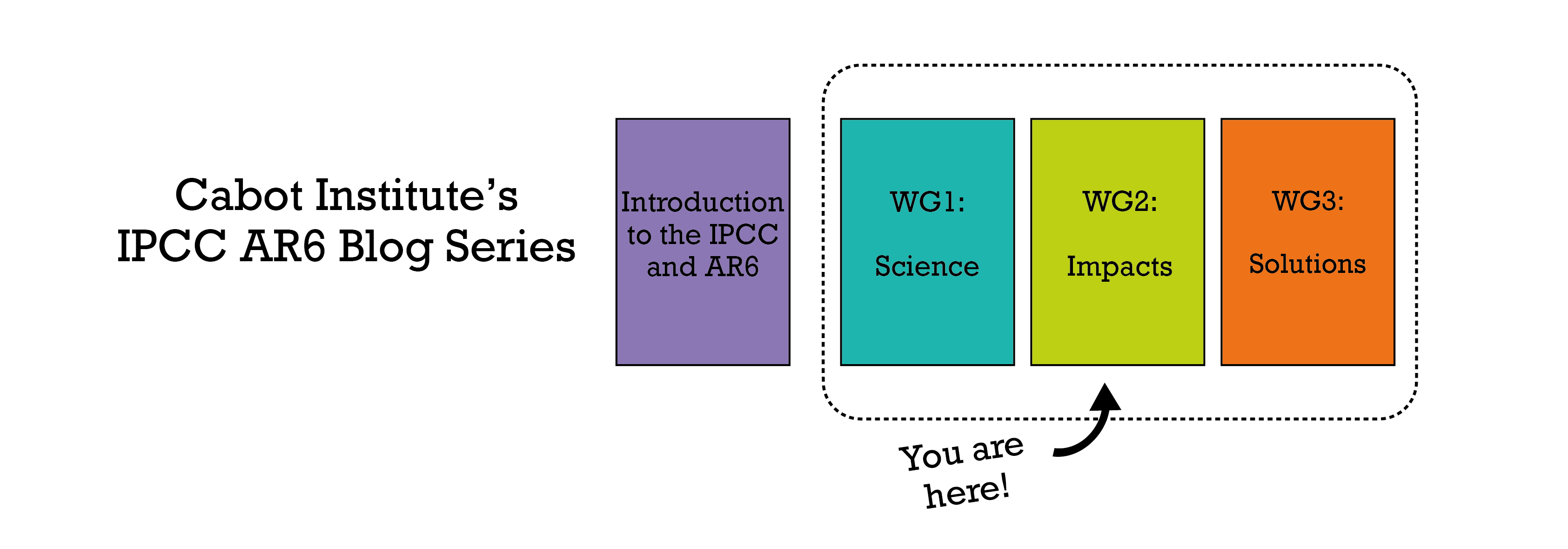
IPCC blog series – Working Group 2 – Impacts, Adaptation and Vulnerability


This blog is part of a series from the Cabot Institute for the Environment on the Intergovernmental Panel on Climate Change’s recent sixth Assessment report, with this post covering the output of Working Group 2 and the impacts of climate change on society and ecosystems. This article also features a chat with Prof Daniela Schmidt, a Professor at the School of Earth Sciences at the University of Bristol, and a Lead Author on the IPCC’s AR6 report. For links to the rest of the series, see the bottom of the post.

Welcome to the next post in this series on the IPCC sixth Assessment Report (AR6). Now that we’ve covered the background science to climate change, the next phase looks at the impacts on society, ecosystems, and the intricate fabric of everything in between – combining the science and aiding the transition of translating to policies that governments can implement to better the planet and mitigate the impacts.

This report is, in my opinion, the most alarming of the bunch – some scientists referring to this as the “bleakest warning yet”. Here are the key points:

The increased frequency of Extreme Weather and Temperature will have a cataclysmic impact – Everywhere will be affected

There is no inhabited region on earth that escapes the impacts of climate change. It’s estimated that over 3.3 billion people are living in areas highly vulnerable to climate change effects – largely extreme temperatures, leading to food insecurity and water shortages. Extreme weather events, such as tropical storms and flooding, are also set to increase in both frequency and severity.

As we’ve seen in recent years, wildfires have become more common (Australia and California making international news) and will continue to rise in frequency – wreaking devastation on communities and wildlife. This, along with the retreat of glaciers and polar ice caps, also results in a release of even more carbon to the atmosphere as the Earth’s natural carbon sinks continue to be dismantled. The ensuing feedback loop amplifies the warming, only serving to increase the severity of these events.

However, the impacts of climate change won’t be experienced uniformly across the planet…

The Impacts of Climate Change will not be experienced equally

This is one of the most important statements from all three Working Groups. It’s been well reported that sea level rise will be existentially cataclysmic for atoll island nations such as Kiribati and the Maldives, but there are other effects of climate change that will be unequally experienced. At the other end of the scale, Britain and other western European nations will see less drastic impacts, despite having some of the greatest contribution to the emissions at the root of the climate crisis. In summer, some parts of the globe are already becoming unliveable due to the extremely high temperatures. In India and Africa for example, where temperatures can exceed 40 degrees C, the number of deaths due to heat are increasing year on year. Poorer communities, especially those who work outdoors, are disproportionately affected as their occupation puts them at greater risk.

Some of the nations with the lowest development and therefore lowest contribution to climate change will experience the impacts more than some of the greatest contributors.

A Climate Crisis exacerbates other ongoing Crises

The effects of a climate crisis add an extra layer of complexity to all sorts of problems the world is already facing. Threats to food and water security because of climate change will increase pre-existing geopolitical tensions as resources become more and more scarce. Therefore, the likelihood of conflict and war increases – which in turn shift focus from fighting climate change. To some extent, we are seeing this already with the war in Ukraine, for example. In summary, climate change can increase severity of a crisis and limits the efficacy of response.

Impacts on ecosystems are already happening as well

Mass die-offs of species are well underway, particularly in oceanic ecosystems as sea temperatures rise and ocean acidification takes place. Deforestation and wildfires are destroying ecosystems.

When I spoke to Professor Daniela Schmidt, a lead author on the WGII report (more from her at the end of the article), she was quick to point out and stress the connections between nature and society, links often underestimated – “Negative impacts on nature will negatively impact people”. Nature, land-use, and conservation will be some of the key tools in helping mitigate the effects of climate change.

This is something to explore further with the next blog in this series on Working Group 3: Mitigation of Climate Change.

Insight from IPCC AR6 Lead Author Professor Daniela Schmidt 

Daniela Schmidt is a Professor of Palaeobiology, Cabot Institute member and a key author on the IPCC’s WG2 report.

How did you get involved with IPCC AR6 and Working Group II in particular?

“I was a lead author on the fifth assessment report, working on the ocean chapter. I have since worked on reports for the European Commission on food from the ocean. I volunteered for this cycle with the expectation of working with WGI but I was assigned work on WGII, which was challenging because it was way out of my comfort zone. Working on this report has changed the way I will conduct research in the future, and has taught me to be more open to the complexities of life”

What’s one key point you’d like to get across from the WGII report?

“The official key strapline from AR6 is that the evidence is clear, climate change is real and happening right now. It’s a rapidly closing window of opportunity to do something about it.”

“One of the main things I like to communicate is that if we don’t hit 1.5 degrees C targets, then 1.7 degrees C is still better than for 2 degrees C example. The point is that every increment matters and that we can’t give up if we miss targets. I think it’s important to tell people that if we are overshooting 1.5 degrees C, yes, there will be consequences, some of which are irreversible, but we can still come back.”

“I also try not just to talk about climate change. Much of the adaptation action for climate change incidentally will, in my view, help to make the world a better place – providing clean drinking water, clean energy, habitable homes and ensuring there is nature surrounding them

———————-

We recommend taking a look at the IPCC’s full reports and report summaries for yourself if you seek to further understand the evidence and reasoning behind their headline statements.

Going further, potential solutions and climate change mitigations will be covered in greater detail in our summary of WG3’s report titled “Mitigation of Climate Change”, will be the next blog in this series, featuring a chat with IPCC AR6 Lead Author Dr. Jo House and contributor Viola Heinrich.

————————–

Andy Lyford

This blog was written by Cabot Communications Assistant Andy Lyford, an MScR Student studying Paleoclimates and Climate modelling on the Cabot Institute Master’s by Research in Global Environmental Challenges at the University of Bristol.

Introducing our IPCC blog series


This blog is the first part of a series from the Cabot Institute for the Environment on the Intergovernmental Panel on Climate Change’s recent Sixth Assessment Report (IPCC AR6). This post is an introduction to the blog series, explaining what we’re aiming to do here and with a glossary of some climate change terms that come up in the later posts. Look out for links to the rest of the series this week.

What is the IPCC?

The IPCC is the Intergovernmental Panel on Climate Change. Formed in 1988 by scientists concerned about the state of the global climate, they’ve been publishing assessment reports on the climate to advise policymakers and governments to act. This year they published their 6th assessment report (AR6), which has been described as their ‘starkest warning’ about the dangers of climate change. The report was built up of 3 Working Groups and over 2800 experts representing 105 countries covering different aspects, from the base science to the sociological impacts of a climate crisis. Alongside their assessment reports, the IPCC also publish special reports on key issues to explore them in more detail. These topics have included Land Use, Impact on the Ocean and Cryosphere and further clarifications on the goal of mitigating 1.5°C global warming.

The IPCC are the most trusted climate group worldwide, with their work being used in policy decisions all over the world.

What are the three Working Groups?

Each of the working groups focuses on a different part of the climate story, looking at causes, effects, and solutions.

• Working Group 1: The Physical Science Basis (WGI)

• Working Group 2: Impacts, Adaptation and Vulnerability (WGII)

• Working Group 3: Mitigation of Climate Change (WGIII)

What is this blog series covering?

The full reports are well over 1000 pages each, with many chapters, subchapters, and footnotes to wade through. As previously mentioned, the full report is split into the domains of the working groups.

Each report from the Working Groups is then filtered down into its own Summary for Policy Makers, which is still dense and features a lot of explanation of evidence. This is further broken down into the headline statements that get released to the press. Even at this level, it’s hard for ordinary members of the public to take the time to read all the evidence and digest the key points.

The aim of this campaign is to distil the key points in each Working Group report in a short, easily understood, and shareable blog as a tool for public outreach. As well as this, the campaign will feature voices from across the Cabot Institute for the Environment including IPCC authors from each of the working groups.

It’s a nearly impossible job trying to filter down the output of thousands of experts into a digestible snippet, but hopefully readers will come away more informed about the IPCC reports and the climate crisis than before.

This week, we’ll be sharing my report summaries here on the Cabot Institute for the Environment blog as well as on Twitter and LinkedIn, starting this Wednesday [27 July] on the output of Working Group I: The Physical Science basis. Keep an eye out for it!

———————————————-
This blog campaign was written by Cabot Institute Communications Assistant Andy Lyford, an MScR Student studying Paleoclimates and Climate modelling on the Cabot Institutes’ Masters by Research in Global Environmental Challenges program at the University of Bristol.

Climate Change 2022: Impacts, Adaptations and Vulnerability – an IPCC lead author report summary

Professor Daniela Schmidt, a lead author of the recently published IPCC (Intergovernmental Panel on Climate Change)  report, Working Group II: Impacts, Adaptations and Vulnerability, recently gave an internal presentation to University of Bristol staff to summarise the report’s findings.

Recent geo-political events have meant that this report has understandably been overlooked in comparison to its predecessor, however, at 3500 pages and being the product of analysis of 34,000 papers since 2014, it is certainly not light reading. This writing aims to pinpoint and amplify the key messages from Daniela’s summary of Working Group II: Impacts, Adaptations and Vulnerability, as the Working Group III: Mitigation of Climate Change report has been released this week.

Solutions

The key take home message, was that the report offers solutions, but they are needed now. Daniela explained that it is not all doom and gloom, and it is important for our survival not to take it that way. From the report itself, the key quote, which you have perhaps seen shared elsewhere, is

The science is clear. Any further delay in concerted global action will miss a brief and rapidly closing window to secure a livable future. This report offers solutions to the world.

Nature

One of the key solutions proposed in the report is nature, both in terms of its conservation and restoration and that it offers promising solutions to many of the threats we face. For example, the potential of natural carbon sinks, coastal protection, water management and urban cooling systems has been repeatedly evidenced, as well as the importance of integrating nature and natural solutions into urban spaces.

The report stresses that humans are part of ecosystems, not separate from them, and nature is crucial to our survival because of the essential and irreplaceable ecosystem services it provides. Fragmented, polluted and overexploited ecosystems are much more vulnerable to climate change, therefore, the report stresses it is therefore important to take a coordinated approach, with their protection and restoration in mind.

Interconnection

As well as the interconnectedness of humans and nature, the report evidences previously unrealised interconnections of climate risks. Risks are becoming more complex and there are compound and cascading risks through systems. For example, in terms of food scarcity, we need to consider that heat stress will not only reduce crop yields, but also the well-being and productivity of farm workers, further exacerbating the situation. There is an increased recognition of the interconnections between people, regions, society, ecosystems, biodiversity. This means that climate change cannot be seen as an individual problem, but as one intrinsically linked with natural resource depletion, ecosystem destruction, and growing urbanisation and inequity across the world.

Equality

Another key focus of the report was the importance of but lack of global equality, which will continue to be exacerbated in the face of climate change. 3.3  – 3.6 billion live in hotspots of high vulnerability to climate change, due to high levels of poverty, limited access to water, sanitation and health services, climate sensitive livelihoods and lack of funding and accountability in government. I would like to point out, that in the vast majority of cases, it is these communities whose carbon contributions are the least, which in my opinion strongly evidences to the fact that climate change is a political problem as well as a scientific one.

Due to inequality being a big problem, the report places an emphasis on the importance of promoting equality in the solutions and with this the need to listen to marginalised voices. Daniela explained that of global climate funding, 80% goes to mitigation, or reduction of emissions, while only 20% goes to adaptation, which is likely to be what is most consequential to more vulnerable communities.

After lack of action on deals made at COP26, which scientists have already argued at best would not be sufficient to solve the problem, a continued lack of action following these urgent messages will be deeply concerning for the fate of the planet, and especially for its most vulnerable communities.

Watch Daniela’s presentation to University of Bristol staff.


——————————
This blog is written by Cabot Institute for the Environment member Hilary McCarthy, University of Bristol.
Hilary McCarthy


What Europe’s exceptionally low winds mean for the future energy grid


Shaggyphoto / shutterstock

Through summer and early autumn 2021, Europe experienced a long period of dry conditions and low wind speeds. The beautifully bright and still weather may have been a welcome reason to hold off reaching for our winter coats, but the lack of wind can be a serious issue when we consider where our electricity might be coming from.

To meet climate mitigation targets, such as those to be discussed at the upcoming COP26 event in Glasgow, power systems are having to rapidly change from relying on fossil fuel generation to renewables such as wind, solar and hydropower. This change makes our energy systems increasingly sensitive to weather and climate variability and the possible effects of climate change.

That period of still weather badly affected wind generation. For instance, UK-based power company SSE stated that its renewable assets produced 32% less power than expected. Although this may appear initially alarming, given the UK government’s plans to become a world leader in wind energy, wind farm developers are aware these low wind “events” are possible, and understanding their impact has become a hot topic in energy-meteorology research.

A new type of extreme weather

So should we be worried about this period of low wind? In short, no. The key thing here is that we’re experiencing an extreme event. It may not be the traditional definition of extreme weather (like a large flood or a hurricane) but these periods, known in energy-meteorology as “wind-droughts”, are becoming critical to understand in order to operate power systems reliably.

Recent research I published with colleagues at the University of Reading highlighted the importance of accounting for the year-to-year variability in wind generation as we continue to invest in it, to make sure we are ready for these events when they do occur. Our team has also shown that periods of stagnant high atmospheric pressure over central Europe, which lead to prolonged low wind conditions, could become the most difficult for power systems in future.

Climate change could play a role

When we think about climate change we tend to focus much more on changes in temperature and rainfall than on possible variations in near-surface wind speed. But it is an important consideration in a power system that will rely more heavily on wind generation.

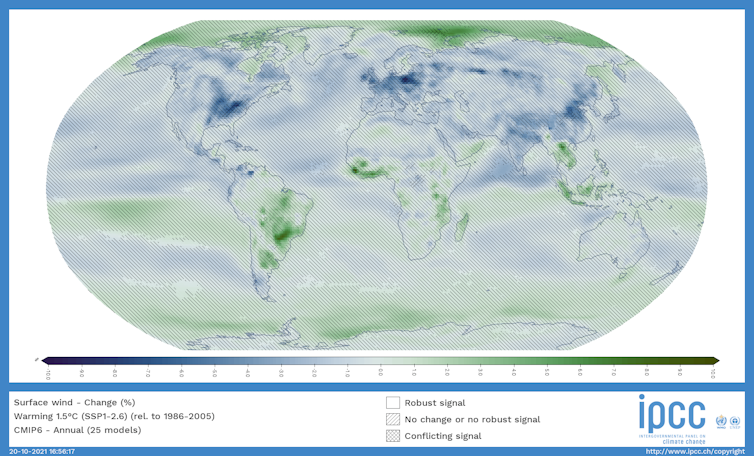
The latest IPCC report suggests that average wind speeds over Europe will reduce by 8%-10% as a result of climate change. It is important to note that wind speed projections are quite uncertain in climate models compared with those for near-surface temperatures, and it is common for different model simulations to show quite contrasting behaviour.

Colleagues and I recently analysed how wind speeds over Europe would change according to six different climate models. Some showed wind speeds increasing as temperatures warm, and others showed decreases. Understanding this in more detail is an ongoing topic of scientific research. It is important to remember that small changes in wind speed could lead to larger changes in power generation, as the power output by a turbine is related to the cube of the wind speed (a cubic number is a number multiplied by itself three times. They increase very fast: 1, 8, 27, 64 and so on).

World map with dark blue (less wind) in Europe, North America and China
Change in wind speed compared to 1986-2005 if we were to limit global warming to 1.5C. Areas in blue will have less wind; areas in green, more wind.
IPCC Interactive Atlas, CC BY-SA

The reductions in near-surface wind speeds seen in the above map could be due to a phenomenon called “global stilling”. This can be explained by the cold Arctic warming at a faster rate than equatorial regions, which means there is less difference in temperature between hot and cold areas. This temperature difference is what drives large-scale winds around the globe through a phenomenon called thermal wind balance.

With all the talk of wind power being the answer to our energy needs, amid spiralling gas prices and the countdown to COP26, the recent wind drought is a clear reminder of how variable this form of generation can be and that it cannot be the sole investment for a reliable future energy grid. Combining wind with other renewable resources such as solar, hydropower and the ability to smartly manage our electricity demand will be critical at times like this summer when the wind is not blowing.The Conversation

——————————

This blog was written the Cabot Institute for the Environment member Dr Hannah Bloomfield, Postdoctoral Researcher in Climate Risk Analytics, University of BristolThis article is republished from The Conversation under a Creative Commons license. Read the original article.

Read all blogs in our COP26 blog series: